
 Enable Ag
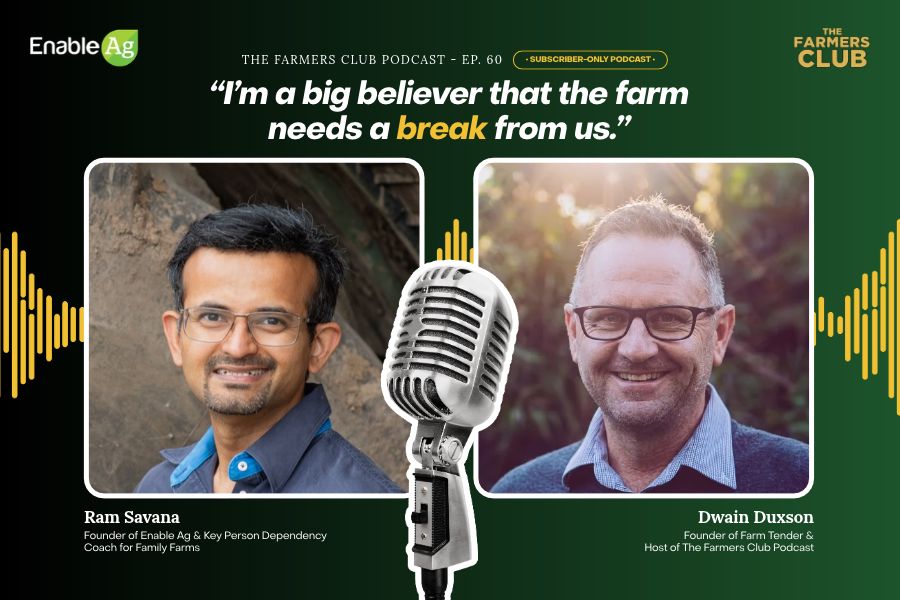
Ram Savana, founder of Enable Ag, recently sat down with Dwain Duxson for Episode 60 of The Farmers Club Private Podcast. Dwain grew up on a mixed farm at Marnoo in Victoria, founded Farm Tender, and now writes The Farmers Club Agletter, written by a farmer, for farmers.
Over 54 minutes, Dwain asked the questions plenty of farmers are thinking: why do we feel guilty when we’re not working? Does any of this work if you’re on your own? And how do you get someone who has never taken more than a week off to step away at all?
The full episode is for Farmers Club subscribers only. Here are five ideas from the conversation worth taking into your own business.
1. The farm needs a break from us
When Dwain asked whether he’s a fan of long breaks, Ram’s answer was the line Dwain picked out for his readers:
“As much as we think that we need a break from the farm, I’m a big believer that the farm needs a break from us.”
A break isn’t just rest. It’s a test. “You step out and see if that organism can hold its character without you.”
In the Enable Ag Program, a two-week break is the minimum, and it gets booked in advance, because, in Ram’s words, “if you don’t lock it, it won’t happen.” Before the break, there’s a framework to follow over about three weeks to get the business ready. After a longer break, there’s another for coming back, so the people who stepped up while you were away stay stepped up instead of handing everything back to you on day one.
The point isn’t more holidays. “It’s about making the farm run or work without the key person.”
2. Busy isn’t the same as productive
Weather, contractors, fuel prices and markets keep farmers in reactive mode more than most industries. So time spent sitting down to think and plan can feel like not working at all.
Ram’s test is simple:
“Would you pay a manager to sit and plan? Then it’s work when you do it too.”
The guilt, he says, “comes from measuring yourself by hours.” The real cost is somewhere else: “The jobs only the owner can do are where the green line gets made. And they are the first to go when they are flat out.”
3. In the business, on the business, and the layer above
Plenty of farmers believe they’re working on the business because they spend their days behind a dashboard, or can turn the pivot on from their phone at the holiday house. Ram doesn’t buy it: “Just because you brought the visibility with you wherever you go on the holiday does not mean that you’re on the business.”
He adds a third layer: the visionary. Where do I want to take this in ten years? What do I want to leave the next generation? And what do I need to do now to get there? In practice, Ram works on a three-year view, breaks it into one year, then quarters, then weeks.

4. Plan the week, not the day
“The week is the quantifiable unit for planning.” Most farmers plan day by day because things change every day, but Ram points out that 60 to 80 per cent of what happens on a farm happens every year, give or take. Block it out. You won’t be 100 per cent right, and you don’t need to be: “Let’s plan to 70%, not 100%.”
Two habits make the difference. First, match the job to your energy: don’t plan at 4pm after a day on the tractor. Second, move the planning. In Ram’s experience, about 90 per cent of farmers plan the coming week on Sunday night, which is family time. Have it done by Friday midday instead, and share it with whoever you work with, whether that’s your partner, your kids or fifteen staff.
5. On your own? Start with capability, not headcount
Dwain asked the question a lot of his readers would have: does any of this work for a sole operator? Ram’s answer: “think about the capability first, not the head count.”
Two simple tools make it possible for a neighbour, a parent or a casual to step in and help without you training them from scratch:
- A farm calendar showing what’s happening and when. A whiteboard is fine.
- A systems list: one place where someone can find how each job is done. A system doesn’t need to be a ten-page document. “A simple video showing how to do a particular job is a system.” For experienced people, Ram prefers a one-page checklist with a QR code linking to the video.
Ram runs Enable Ag the same way
Dwain asked whether Ram practises what he preaches. In 2022, Ram took four months away from the business and logged every hour he worked. He was working 27 per cent of the time, so 73 per cent of the business ran without him. He put more systems in place, went away again for six weeks, and measured again: 11 per cent.
Dwain also asked about Frank Archer of Landfall Angus, who took a three-month family break after working with Enable Ag. You can hear Frank tell that story himself on The Angus Table podcast.
Where to start
Ram’s advice was not to try to fix everything at once. “Don’t work on a zillion things. Rather, you pick that one.”
That’s why we built the free Business Independence Quiz. It takes 5 minutes and shows you which area of your business has the most leverage, so you know where to start. Take the free Business Independence Quiz.
Hear the full conversation
Episode 60 is available only to subscribers of The Farmers Club, along with 50+ other conversations and Dwain’s Agletter. Find out more at The Farmers Club.
Thanks to Dwain Duxson and The Farmers Club for having Ram on the show.